
Four-Pendulum Oscillation Model
Demonstrating coupled vibrations, resonance, and the beat phenomenon.
track_changes Purpose
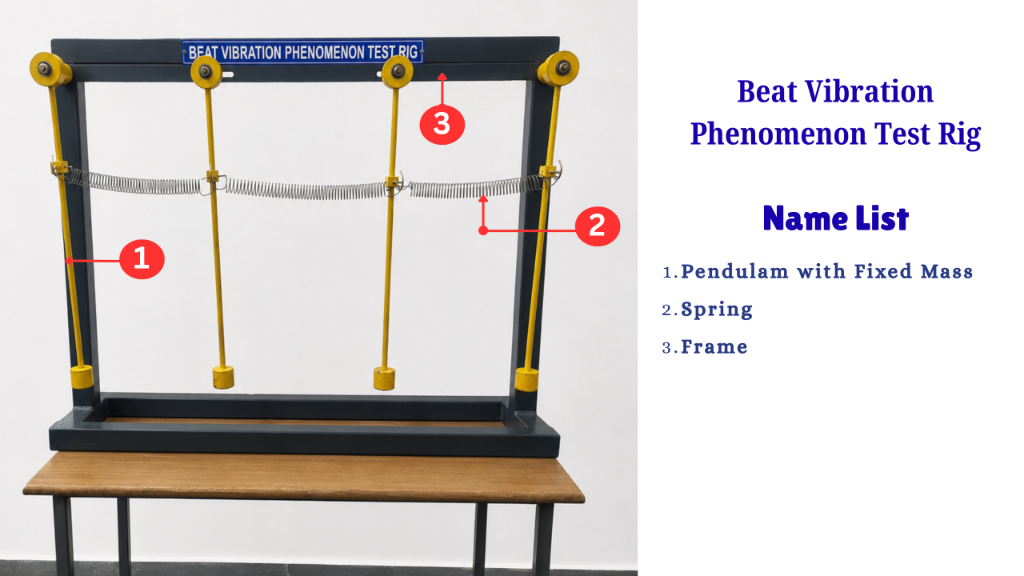
The Four-Pendulum Oscillation Model demonstrates oscillatory motion, resonance, synchronization, and energy transfer.
menu_book Theory
The apparatus consists of four identical pendulums suspended from a rigid support. Adjacent pendulums are connected by light springs, forming a coupled oscillating system. When one pendulum is displaced and released, the springs transfer energy to the neighboring pendulums. This causes:
- Beat phenomenon: Periodic increase and decrease in the amplitude due to energy exchange.
- Resonance: Large oscillations occur when the excitation frequency matches one of the natural frequencies of the coupled system.
- Coupled vibrations: The pendulums oscillate together in different vibration modes depending on the spring stiffness and initial conditions.
science Experimental Procedure
Part A: Beat Phenomenon
- Place the apparatus on a stable, level surface.
- Check that all four pendulums have identical masses and equal rod lengths.
- Ensure the coupling springs are securely connected between adjacent pendulums.
- Bring all pendulums to their equilibrium position.
- Displace only the first pendulum by a small angle (5°–10°).
- Release it gently without applying any additional force.
- Observe the oscillations of all four pendulums.
- Note how the amplitude of the first pendulum gradually decreases while the amplitudes of the other pendulums increase due to energy transfer.
- Continue observing until the energy returns to the first pendulum, completing one beat cycle.
- Repeat the experiment several times and record the beat period.
Part B: Resonance
- Apply a periodic excitation to one end pendulum or to the support (depending on the apparatus design).
- Start with a low excitation frequency.
- Increase the excitation frequency gradually.
- Observe the response of all four pendulums.
- At resonance, one or more pendulums will oscillate with maximum amplitude.
- Record the excitation frequency corresponding to the maximum response.
- Repeat the test for different spring stiffness values if adjustable.
lightbulb Key Concepts
1. Excitation Frequency
The excitation frequency is the frequency of the external force that is applied to the pendulum system.
For example:
- If you move one pendulum back and forth by hand at a constant rate, the rate at which you move it is the excitation frequency.
- If the apparatus uses a motor or shaker to oscillate the support, the motor's oscillation frequency is the excitation frequency.
It is controlled by the experimenter. Example: You excite the system at 1.5 Hz, meaning the external force acts 1.5 times per second.
2. Natural Frequencies
The natural frequencies are the frequencies at which the coupled pendulum system oscillates on its own after being disturbed and released.
In a system of four coupled pendulums, there is more than one natural frequency because the pendulums are connected by springs. Different vibration patterns (called normal modes) have different natural frequencies. These frequencies depend on:
- Mass of each pendulum
- Length of the rigid rods
- Spring stiffness (coupling strength)
- Gravitational acceleration
The natural frequencies are properties of the system and cannot be chosen by the experimenter.
Relationship Between Excitation & Natural Frequency
- If the excitation frequency is different from the natural frequencies, the pendulums oscillate with relatively small amplitudes.
- If the excitation frequency becomes equal (or very close) to one of the natural frequencies, resonance occurs and the oscillation amplitude becomes very large.
Simple Example:
Suppose a four-pendulum system has natural frequencies of: 0.95 Hz, 1.05 Hz, 1.18 Hz, 1.30 Hz.
- 0.80 Hz → Small oscillations
- 1.05 Hz → Resonance occurs because the excitation frequency matches a natural frequency.
- 1.25 Hz → Moderate response, since it is close to but not exactly at a natural frequency.
Beat Phenomenon
The beat phenomenon occurs when two natural frequencies are very close together. Energy is transferred back and forth between the pendulums, causing the oscillation amplitude to alternately increase and decrease over time.
| Term | Meaning | Controlled by |
|---|---|---|
| Excitation Frequency | Frequency of the external driving force applied to the system | Experimenter |
| Natural Frequency | Frequency at which the coupled pendulum system oscillates freely after being disturbed | Determined by the system's mass, rod length, and spring stiffness |
In your laboratory experiment, you observe beats by displacing one pendulum and releasing it, while you observe resonance by varying the external excitation frequency until it matches one of the system's natural frequencies.
school Learning Outcomes
- Understanding simple harmonic motion.
- Studying resonance phenomena.
- Observing coupled oscillations.
- Analyzing energy transfer between vibrating systems.
engineering Engineering Applications
stars Benefits
The model provides a visual understanding of how resonance develops and why controlling vibration frequencies is important in engineering design.